A big month — a completely rebuilt mobile app, more than 80 new asset types with their UK regulations attached, a wave of new inspection checklists for building safety, vehicles, and open spaces, and a redesigned task and asset experience in the web app. Everything below is live on the platform now.
Mobile app v2.0
Our biggest mobile update yet. The app has been rebuilt under the hood, and the difference is immediate.
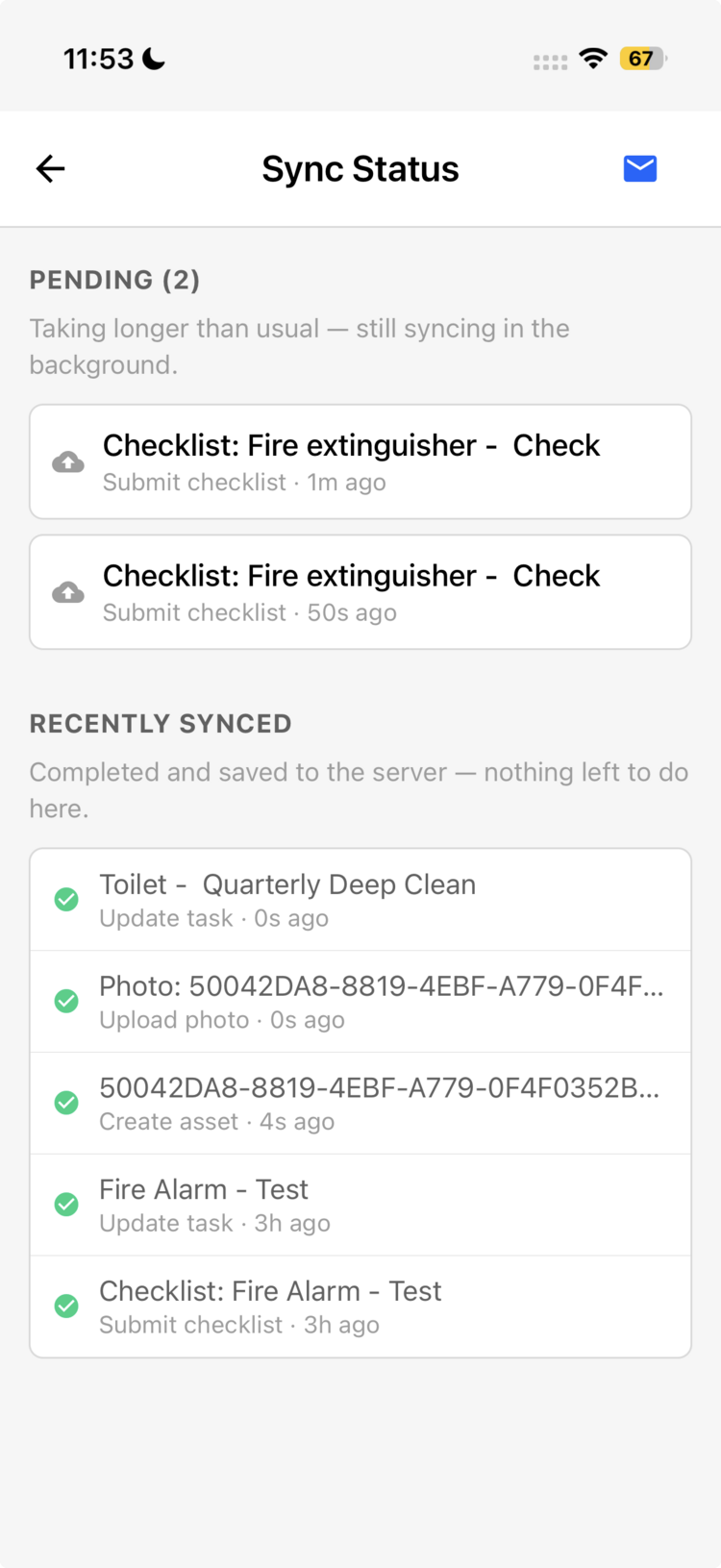
Offline working. You can now carry out inspections, log defects, and complete tasks without a signal. Everything syncs automatically when you're back in range — no lost data, and no re-entering work you've already done.
Live photo upload. Photos upload in real time as you take them, rather than batching at the end of a session. If the connection drops, they queue and upload the moment signal returns.
Quicker task creation. Creating a task now takes fewer taps. The most common fields are front and centre; the rest are a scroll away.
New checklists, day one. The new vehicle, building safety, and open space checklists are all available in the app from launch — see the checklist sections below for what's new.
Easier sign-in. Returning users stay signed in across sessions. First-time sign-in now supports a simpler email-link option alongside the existing password route.
A bigger asset catalogue
More than 80 new asset types have been added over the past month, filling in areas that previously had thin or no coverage:
- Skatepark equipment (11 types) — Half Pipe, Quarter Pipe, Spine Ramp, Funbox, Pump Track, Skate Bowl and more. Each is linked to BS EN 14974+A1:2019.
- Golf course (29 types) — Putting Green, Fairway, Bunker, Tee Box, Driving Range, Water Hazard, Golf Buggy and more, across five sub-categories.
- Building safety (6 types) — Fire Door, CO Alarm, Smoke Detector, Heat Detector, Thermostatic Mixing Valve (TMV), and Calorifier — added to support the new building safety checklists.
- Building services and compliance (24 types) — HVAC (Air Handling Unit, Ventilation System, Chiller and others), fire suppression (Fire Hose Reel, Sprinkler System, Dry/Wet Riser, Fire Hydrant), electrical (Distribution Board, Fixed Electrical Installation, RCD), gas and heating, lifting equipment (Passenger Lift, Hoist), and fabric/water items (Chimney, Lightning Protection System, Cold Water Storage Tank). Air Conditioner has moved into the Energy Amenities sub-category.
- Parks, green spaces and depots — Emergency Exit Sign (linked to BS 5266-1:2022), plus biodiversity and depot types.
- Civic regalia — Ceremonial Headwear and Common Seal added, with extended synonyms for Robes and Civic Badge.
- Maintenance equipment — Eye Wash Station, Fire Document Box, and Floor Cleaner.
Every new type ships with the Simple Checklist as its default inspection, plus at least three synonyms to help bulk-upload matching find the right type.
Regulations linked to assets
Every type where a UK standard applies now has its regulations linked in the catalogue. New standards added this period include BS EN 14974+A1:2019 (skatepark equipment), 26 vehicle-related regulations covering LOLER, PUWER, DVSA, the Boat Safety Scheme and relevant BS/EN standards, and 15 building safety standards spanning fire suppression, water/Legionella, emergency lighting, gas, and lifting.
These links drive the regulations panel on each asset's record and will support compliance reporting in a future release.
New building safety checklists
Fourteen new checklists cover the duty-holder routine check cycle for building safety equipment — these are the checks your team carries out, not the statutory contractor inspections.
- Fire and life safety — routine checks for fire extinguishers (monthly), fire alarms, CO alarms, smoke and heat detectors, fire doors, fire blankets, and emergency lighting.
- Emergency equipment — routine defibrillator and first aid kit checks.
- Access and heating — routine lift, ladder and access equipment checks, plus an annual boiler check.
- Water and Legionella — five checklists covering water outlets, calorifiers, cold water storage tanks, thermostatic mixing valves, and showers, with numeric temperature fields and advisory Legionella thresholds noted in the help text.
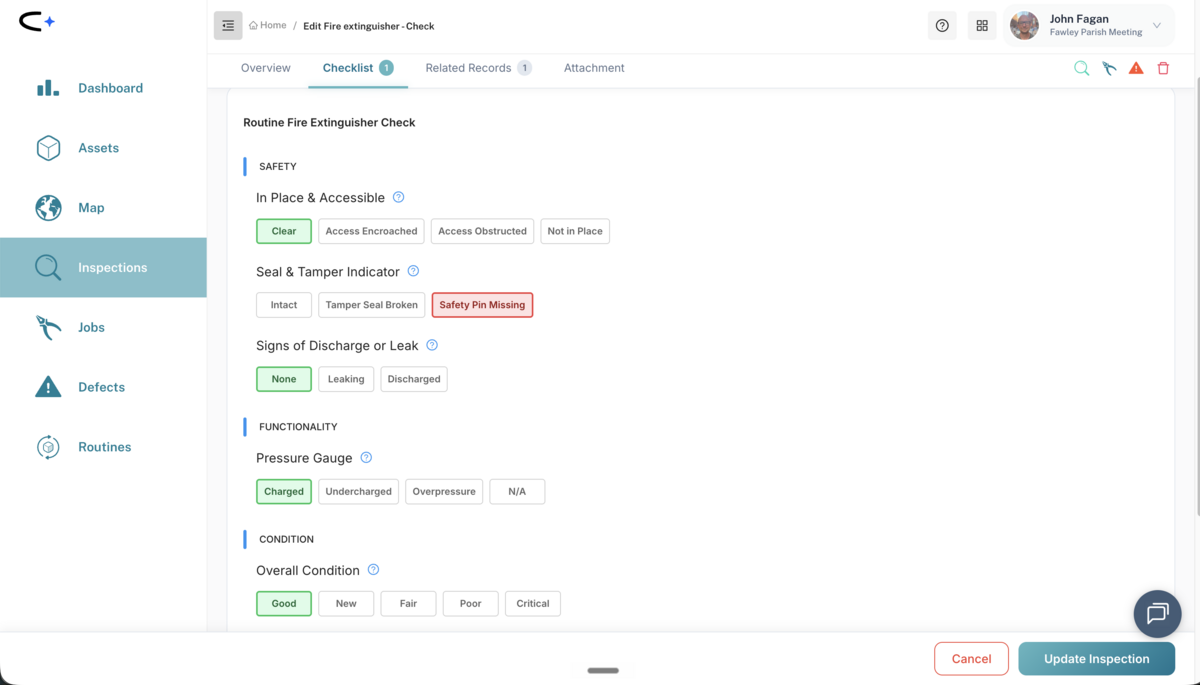
All building safety checklists use colour-coded responses that describe what you actually see — from a clear pass through to a critical fault, and the response you pick pre-fills the defect. Mark a fire extinguisher as Safety Pin Missing and the app offers a "Fire extinguisher - Safety Pin Missing" defect, ready to raise in one tap. The inspector chooses whether to create it.
Vehicle checklists — Check and Sweep
Every driven and towed vehicle type now has two checklists in the dropdown:
- Check (graded) — a quick pre-use or routine inspection covering broad condition areas (lights, tyres, fluid levels, bodywork, load security, safety equipment). A few minutes at the start of a shift.
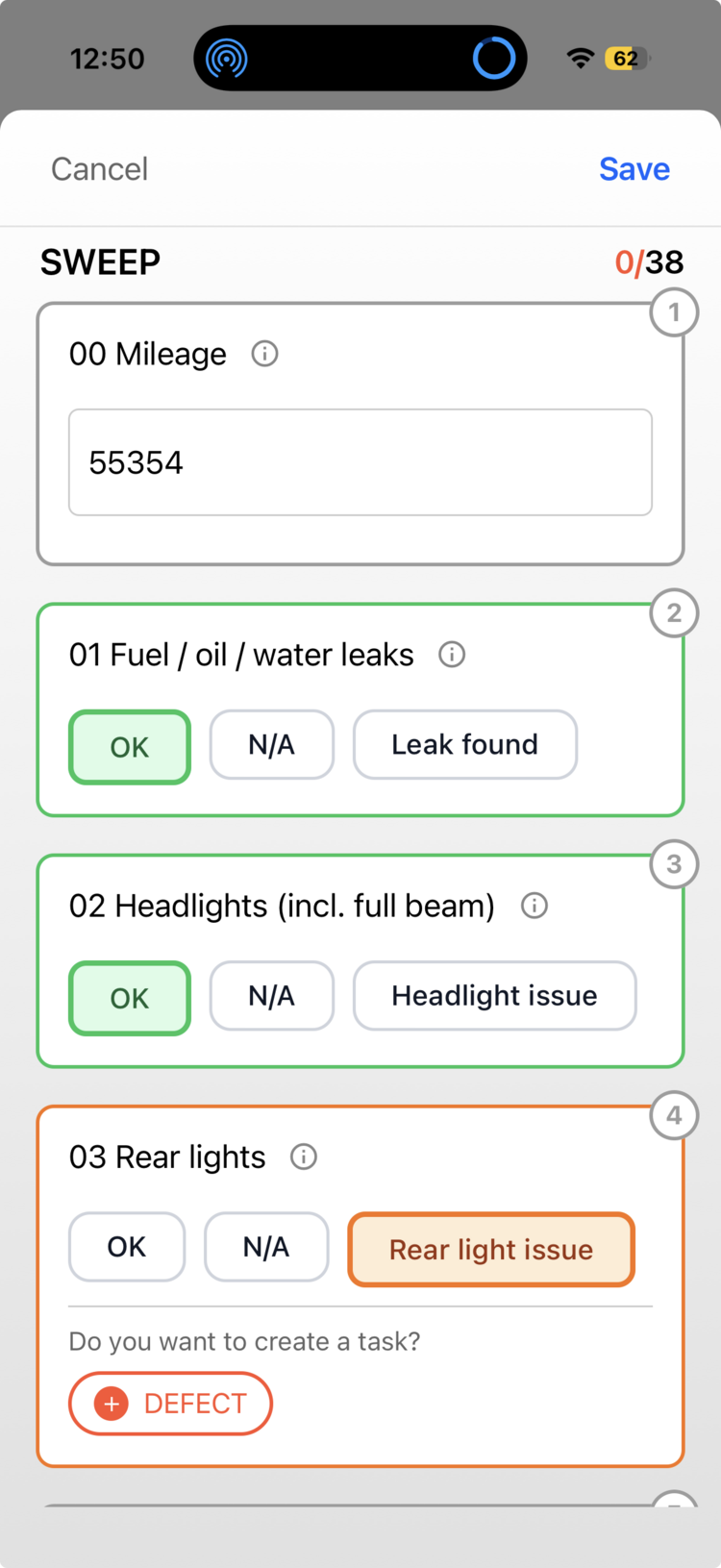
- Sweep (per-item) — a detailed walk-around covering every physical item in order, with an OK / N/A / fault response. Only a fault offers a defect to raise, keeping the record clean. Built for a thorough weekly or periodic check.
Both are live for 23 vehicle and plant types — cars, vans, tippers, flatbeds, minibuses, tractors, mowers, street sweepers, forklifts, cherry pickers, golf buggies, and boats among them. Both record Mileage or Engine Hours as a usage reading against the task automatically, and both are linked to the applicable regulations (MOT legislation, LOLER, PUWER, the Boat Safety Scheme, and vehicle-specific BS/EN standards) based on type.
These new checklists replace the older vehicle checklists — Vehicle Pre-Use Inspection, Vehicle Operational Inspection, and Vehicle Annual Compliance — which predate this framework and don't have regulations linked. We'll retire those gradually rather than switch them off overnight: they stay in the dropdown for now so nothing changes mid-routine, and we'll help you move across to the new Check and Sweep checklists at your own pace. There's nothing you need to do today.
Open space sweeps
Eight area sweeps are now live, giving field teams a single cover-everything checklist for each round: Park Sweep, Playground Area Sweep, Sports Ground Sweep, Cemetery Sweep, Allotment Sweep, Water Body Sweep, Car Park Sweep, and Woodland & Nature Sweep.
Each uses the per-item OK / N/A / fault format — one question per item, and a fault offers a defect to raise. Fields cover boundary integrity, surfacing, drainage, lighting, signage, litter, graffiti and vandalism, safety equipment, and site-specific items (play equipment for a playground, headstones and kerbing for a cemetery, water clarity for a water body). Sweeps run at a routine, weekly cadence by default and are mapped to the relevant open space asset types.
Grass cutting now records growth
The Grass Cutting job checklist now includes a Grass Growth field with a graded response — Dormant / Slow / Moderate / Active / Rapid — so field teams can log current growth conditions alongside the completed cut. This feeds into the asset's condition record and gives supervisors a seasonal overview without a separate inspection.
Web app improvements
The web app's two main detail screens have been rebuilt around tabs, so the information you need is grouped instead of stacked down one long page.
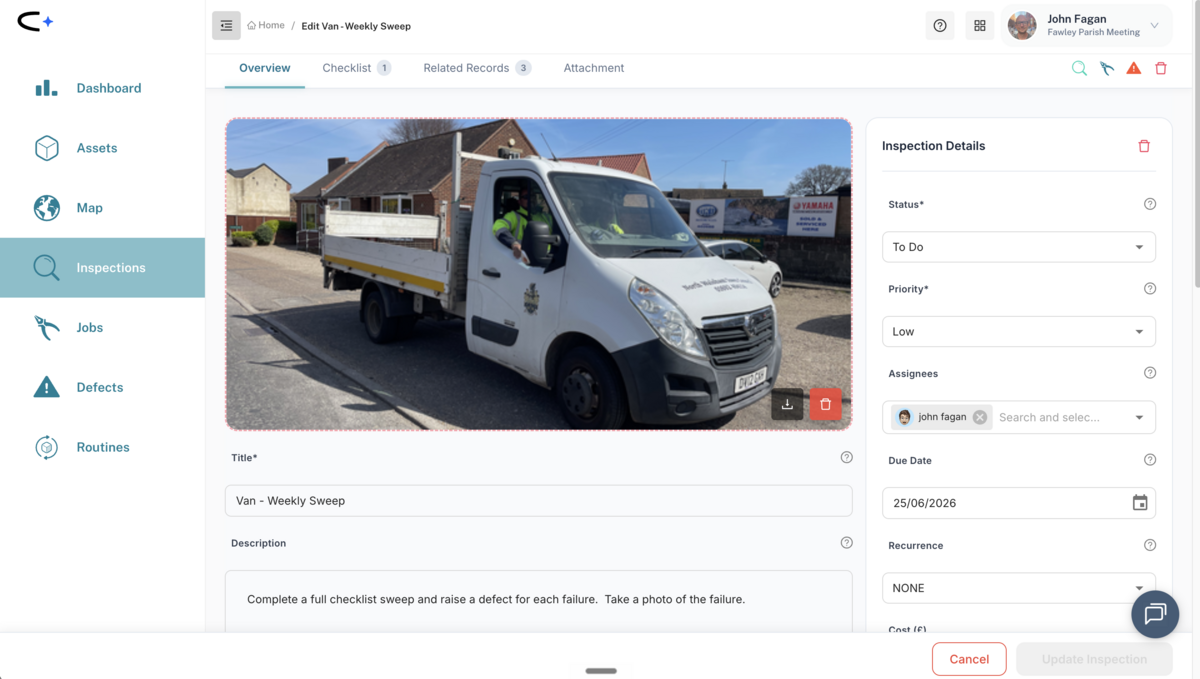
The task screen, redesigned. Opening a task now splits its detail across Overview, Checklist, Related Records and Attachment tabs, with the things you change most — status, priority, assignees, due date — grouped in a panel down the right. On the Related Records tab you can now show or hide completed tasks, and a progress indicator briefly blocks the screen while a task saves, so a slow connection can't lead to a double-submission.
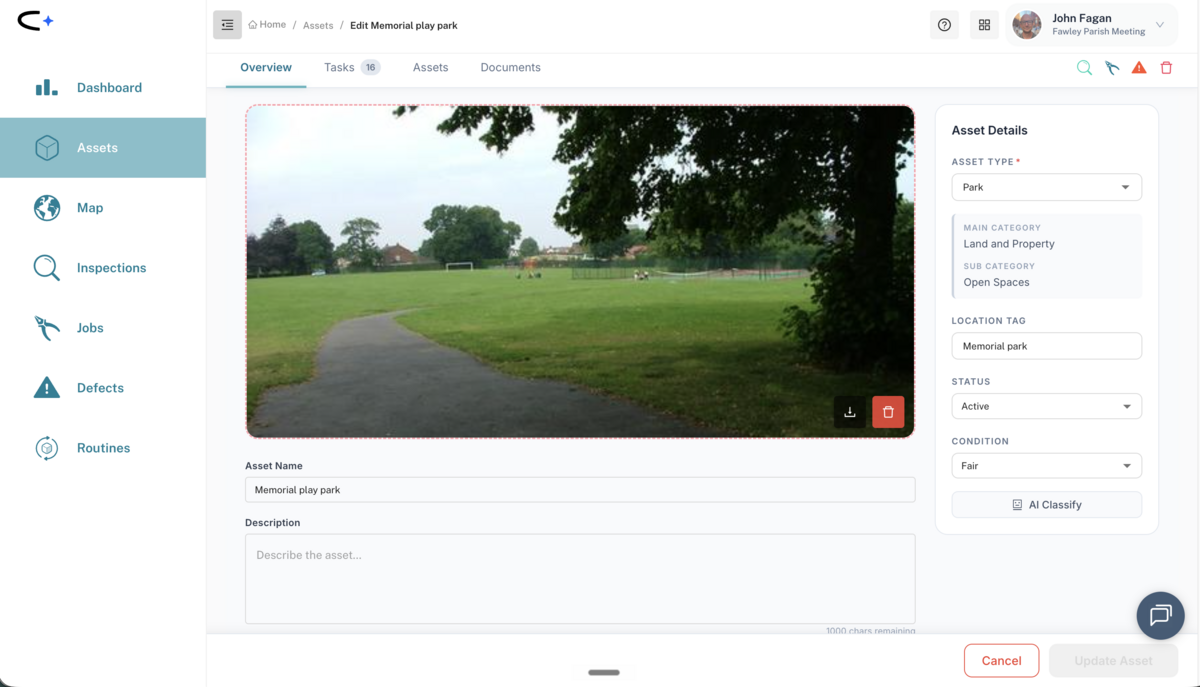
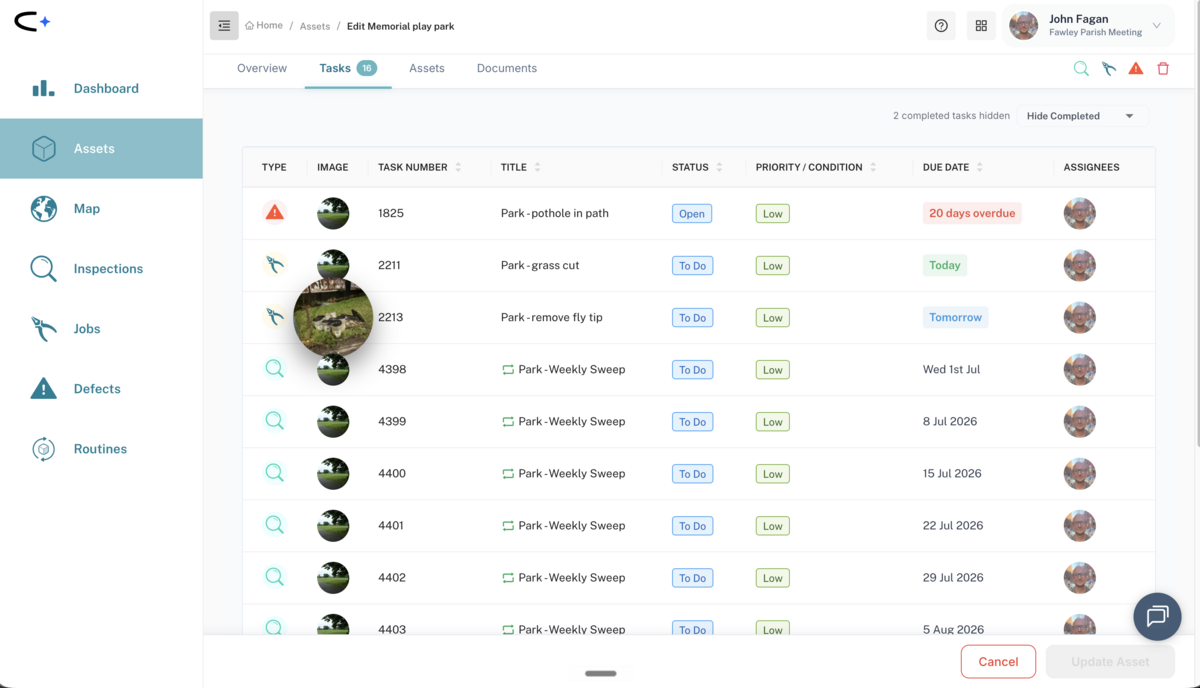
The asset screen, redesigned. Asset records now open on an Overview tab, with Tasks, Assets and Documents alongside. The Tasks tab is the handy one: it lists every task linked to that asset in one place — what's overdue, what's due today and tomorrow, and every upcoming recurring cycle — with type, status, priority and due date at a glance. Completed tasks can be hidden to keep the list focused on what's outstanding.
Simpler user management. Inviting a new user now sends a one-click invite link rather than a temporary password, and invited users no longer have to change their password the first time they sign in. We've tidied the wording of the account emails that go out, and the system now stops the last remaining administrator from removing their own admin access.
Fixes
We also cleared a batch of issues across the web app this month — faster switching between list and grid views on the asset register, checklist responses now showing correctly in the list view, side drawer and CSV export, and several bulk-edit fixes covering task priority, status and deletion. Behind the scenes, we made a series of corrections to how recurring routines generate their tasks, improving schedule accuracy for the councils affected.
Coming next — HVAC and building compliance checklists
The 24 new building services and compliance types (HVAC, fire suppression, electrical, gas, lifting) are live in the catalogue now and can be used with the Simple Checklist default. Bespoke checklists for them are being written, starting with HVAC — covering F-Gas Regulation (GB) 2015, BS EN 378-1:2016, and BESA TR/19 cleaning standards — and extending through fire suppression (BS EN 12845, BS 9990, BS 750, BS EN 671), electrical (BS 7671:2018+A2:2022), and gas and lifting equipment. These will follow the same Check-style format as the rest of building safety. We'll post another update when they roll out.
In your hands
Everything above is live now. Keep the ideas coming at ideas.civic.ly, and if you have any questions about the new checklists or asset types, contact your customer success manager or email us at hello@civic.ly.
Common Questions
No. The web app and mobile app update automatically — refresh your browser, or close and reopen the app, to pick up the latest version. The mobile v2.0 update may prompt you to update through the App Store or Google Play.
A Check is a quick graded inspection of broad condition areas — ideal for a pre-use look at the start of a shift. A Sweep is a detailed item-by-item walk-around for a thorough weekly or periodic check. Both are in the checklist dropdown for every vehicle type, and you choose whichever suits the job.